
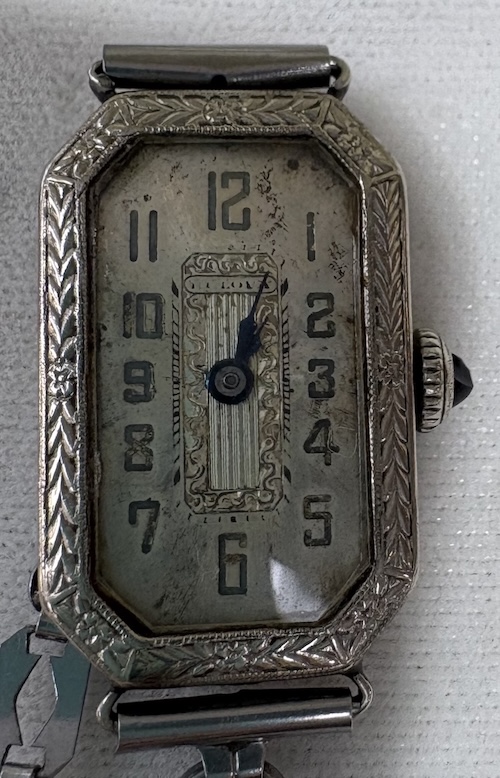
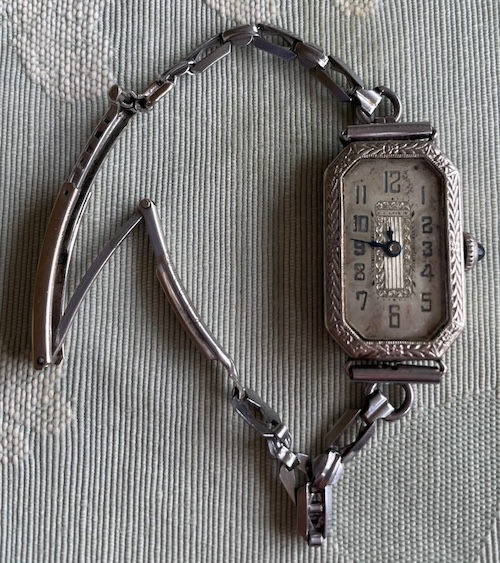
I rediscovered this watch in my jewelry box a few months ago and had the vague memory that it was my grandmother’s watch but not the one she usually wore. I showed it to my mother and it looked familiar to her, but she was quite sure she hadn’t seen her mother wearing it. Usually we both remember things like this, so it is unfortunate that we don’t in this case.
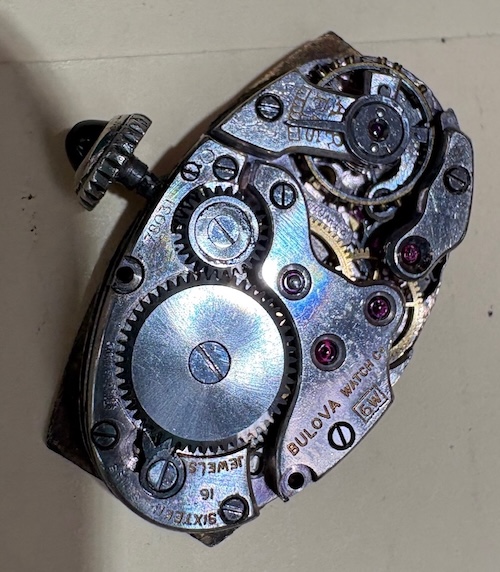
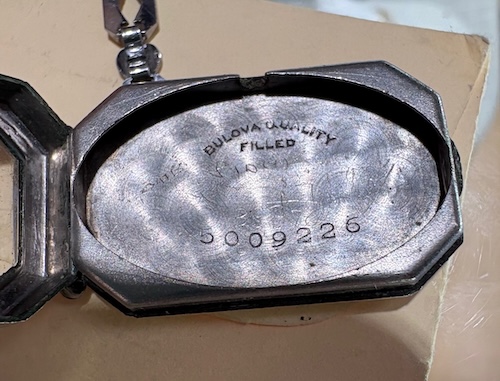
From lots of enjoyable and educational looking around this website, I think it is likely that the watch is a Pater. I see a circle-shaped symbol on the movement by two screws near the crown, which I believe indicates it was made in 1925. I’m very interested to know if you concur with that style and date. 16 jewels seems to be unusual, and I wonder if there’s any information to be gleaned from that.
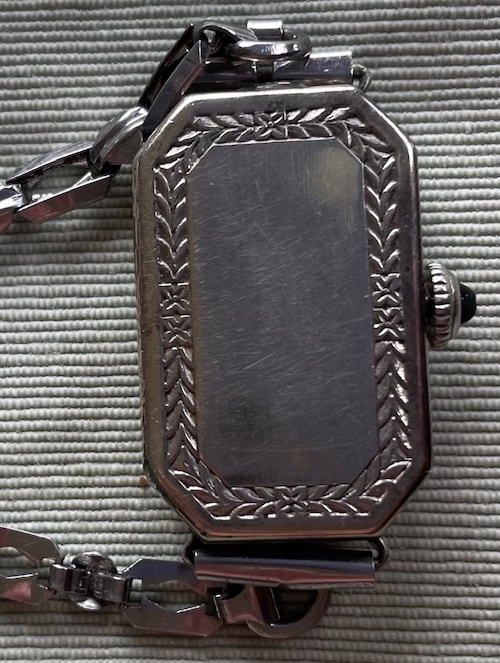
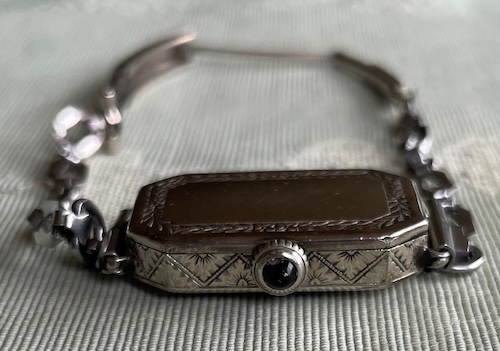
My grandmother graduated from high school in 1925 and then, in 1926, finished an extra year in another high school to learn secretarial skills. Her parents were farmers and their financial situation was such that it is very unlikely they would have bought her a gift like this watch. But she worked, boarded, and sometimes traveled with a wealthy family as a nanny so she could stay in Portland, Oregon to attend high school. Our leading theory is that they bought her the watch as a graduation gift. If so, my guess is that she wore it regularly for a while—it shows signs of wear on the back and has a chip on the sapphire—and then got another watch around the time of her marriage or when my mother was very young, which would be the mid-to-late 1930s. This is a lot of speculation, but if you notice anything about the watch that supports or confirms this theory or notice anything that might suggest anything else about its story, I’d love to know.
Another theory is that she found the watch at a yard sale. She always looked for finds and had some good ones.
The bracelet strap fits me well and I wonder if someone had it fitted for me. The bracelet seems to be newer and a different material from the watch and clasp, which both seem to be white gold, filled gold in the case of the watch. The clasp says, “Kreisler quality USA gold cont. .025-pat.2.064760.” That patent is from 1936 (https://www.uspto.gov/web/offices/ac/ido/oeip/taf/filingyr.htm), so the clasp is not the original.
We took the watch to a jeweler. The spring was broken, and we had it replaced. We had it cleaned, though asked for just a light dusting of the face. The watch is working now.
I’m enjoying wearing it and am not interested in selling it.
In reply to It would be great to finally… by mybulova_admin
That is a deduction from many small facts, too many to summarise in a one-liner. Like in today’s world, they may have had some stock on fast moving items like cases for the Princine. They also would have to make estimations for their movement inventory given the shipping time from Switzerland, but like today, you want to keep inventory as low as possible (=days, not weeks or months) and push inventory to the jewelers I.e. as close to the customer as possible to get the sale.
In reply to That is a deduction from … by Alex
I tend to have a different opinion based on common practices at the time of the major watch manufactures.
AI aligns with my way of thinking.
**************************
By the mid-1920s, U.S. watch manufacturing had largely shifted to a batch (stock-based) production system, not build-to-order in the modern sense.
Here’s how it typically worked:
Mass production was the norm
Companies like Elgin National Watch Company, Waltham Watch Company, and Hamilton Watch Company were pioneers of industrialized watchmaking. By the 1920s, they were producing standardized movements and components in large batches using assembly-line techniques.
- Movements (the internal mechanism) were made in runs of a specific grade and model
- Parts were interchangeable, a hallmark of American watchmaking
- Production planning was based on forecasted demand, not individual customer orders
Inventory-first, then sold through retailers
Rather than making watches only after an order came in:
- Manufacturers built inventory in advance
- Watches (or sometimes just movements) were shipped to jewelers and distributors
- Retailers then sold to customers from stock
This system allowed for:
- Faster fulfillment
- Lower costs per unit
- Broad national distribution
Some customization still existed—but at the retail level
While the factory didn’t usually build a watch from scratch for a specific customer:
- Customers could choose case styles, dial designs, and grades
- Retail jewelers often cased movements locally (buying movements and cases separately and assembling them)
- Engraving and minor personalization were common
So in practice, a customer might feel like they were “ordering” a watch, but the core components were almost always already manufactured in batches.
Exceptions: high-end or special orders
There were limited exceptions:
- Premium models or railroad-grade watches might be produced in smaller, more controlled runs
- Very high-end or presentation pieces could involve special assembly or finishing
But even these were usually drawn from pre-made parts rather than built entirely from scratch per order.
Bottom line:
By the 1920s, U.S. watchmakers overwhelmingly followed a mass production + inventory model. Watches were made in batches based on expected demand, then sold through retailers, with customization happening mostly after production rather than driving it.
So we have 3 models to choose from, all of which are correct and based on when the watch was sold.
- Early - Mid (Spring) 1925 = 6513 (6613)
- Mid - Late (Fall) 1925 = Bulova Patria & Pater
Geoff and Alex, is there a particular reason you are discounting the 6513 (6613) model?
*I've edited this post to swap the seasons around. I forgot I live in the southern hemisphere :-)
In reply to So we have 3 models to… by mybulova_admin
It is nicer to have a name than a number. 😁
Bulova started experimenting with names in their December 1924 newspaper campaign. Ads in American Magazine and Saturday Evening Post continued for some months with the number designation. Why? We don’t know. Maybe the ads were already prepared and it cost money to redo them? Maybe not everybody in the Bulova board was convinced yet? Fact is, as from September 1925, all ads show names now, confirming the December 1924 Patria name. Since I like a name better than a number, I say Patria.
In reply to It is nicer to have a name… by Alex
Alex, which December 1924 advert are you referring to as showing the Patria model name?
In reply to Alex, which December 1924… by mybulova_admin
I checked and see it is not on this website. I will send to your email. It is from the December campaign and you will find many on newspapers.com
In reply to I checked and see it is not… by Alex
I wonder if there might be an advertisement for these watches in a Portland, Oregon newspaper in that time period. I don't have a newspapers.com subscription now, or I'd look myself, but, if it's not too much trouble, you might take a look.
Many thanks again to all posting for your research and thoughts on this.

In reply to I wonder if there might be… by KarinEg
This one is from Chehalis, Washington, pretty close to Portland, Oregon! The_Chehalis_Bee_Nugget_1924_12_12_Page_19

In reply to This one is from Chehalis,… by Kathy L.
Thank you for finding that. That's fun to see and think of it being close to where my teenage grandmother was!
In reply to I checked and see it is not… by Alex
Thanks Alex.
Based on this advert, let's go with the name. 1925 Bulova Patria.
