
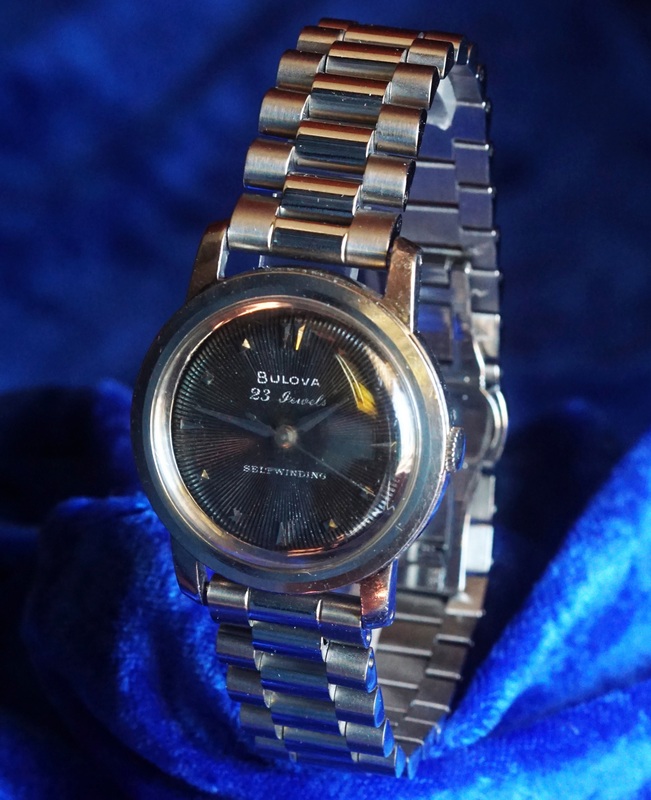
Bulova 23 Jewel 10BPAC auto L5/L4 ss
Case Dimensions and features:
- Width w/o Crown: 33.85 mm
- Length: 40.95 mm
- Depth: 7.95 mm wo/crystal, 12.10 mm w/crystal
- Lug Width: 17.35 mm
- Crown: 4.50Dia mm, unsigned
- Crystal: 27.85Dia mm, in bezel. Shallow Domed Acrylic
- Bezel O.D.: 33.30 mm
- Case Back O.D.: 28.95 mm
- Case Back thread O. D.: 27.50 mm
- Inside case back inscriptions: Bulova Watch Co.; Stainless Steel; Swiss; Brevet; a “Swiss Cross”; 260126; Perlage finishing; faint watchmaker engravings
- Outside case back inscriptions: Bulova; Stainless Steel; Shock Resistant; 6013564; L6; Anti-Magnetic; Self-Winding; Waterproof
- Movement: 10BPAC 23 Jewel Automatic, No Date
- Engraving on Movement: On Rotor BULOVA WATCH CO; 10BPAC; U.S.A.; 23 Jewels. On Bridge: L5
Notes: The MyBulova database (that is available to me) has three examples of models with this case. Other than the black dial, this would appear to be a “23R”, one example seen here: https://mybulova.com/watches/1956-bulova-23-r-12247
At first glance, this an understated design and something of a departure for Bulova in this era. Under closer inspection it becomes evident that this is one of Bulova’s earlier forays into “dive watch” specifications, at exactly the timeframe that Blancpain, Rolex, Doxa (and to a lesser extent, Squale) were all introducing their now iconic divers. The case, though not quite as serious as an EPSA “compressor”, is none-the-less rather impressive for it’s time. From the compressor-like internal springs in the case back, to the super stout build and protected crown, it is obvious that it was purpose- built to withstand significant water pressure. I would speculate that, with servicing and new case and crown seals, this watch could test to 50 meter easily. The minor wear that this watch exhibits would suggest that replacing the crown would not be required to pass such a 5 ATM water pressure test. The inscription “Brevet – Swiss Crown – 6013564” is the Swiss Patent Number for this case design. Overall, this configuration closely follows the direction Omega was taking for “waterproof” watches in this era, and even outdoes the “beefy lug” Seamaster in respect to case thickness and sealing technology. The drilled lugs are just the cherry on top of this ultra vintage design.
Well, today I got the call I knew was coming…my boss said I have to end my extended vacation tomorrow. I did, however, spend my last couple of idle weeks getting a few more of my Bulovas that aren’t in the database listed. My thanks to the esteemed Panel for selflessly identifying these for me. I learned much, and maybe made a small contribution to this enthusiasm of so many. It is only fitting that I conclude this growth spurt with an obscure Bulova, which just happens to be a personal fave.


Model and case wise I think this is from the Bulova 23 family. The Bulova 23 "Q" has the same case as yours as shown here in these examples: (note the hidden lug style, which I believe would be the same as your watch, which I think has a larger none orignal crown).
- https://mybulova.com/watches/1956-bulova-23-q-11078
- https://mybulova.com/watches/1956-bulova-23-q-13487
Your watch may be another variant of the 23, or the black dial might have originated from one of the other black dial versions from the 'Bulova 23' family. The Bulova 23 "A" has users dial.
If you can confirm that the black dial is original to the watch then I say we have yet another Bulova 23 variant, otherwise I'd suggest an generic 'Bulova 23' ID, as it may be a combination of the "Q" or "RW" case and the "A" dial variants.


In reply to Model and case wise I think… by mybulova_admin
Hi
I already have a "Q" version, and this looks nothing like it in real time. This watch has lugs that are fatter, shorter, not facetted, barely tapered, and have drilled lugs. The case from dial to case edge is also much thicker. The "R" and "RW" are the exact case, and notably they are quasi-dive watches, indicated by the substantial builds, features, and specific Swiss patent. As far as if this dial came with the case....I was six years-old when it was made (smile), so I am guessing when I say that it appears to be. I added the close-up of the dial just to ascertain this aspect, since I did not find the same configuration in the database. One of the cream dial "R" models does have similar hour indicators and printing, as well as identical case back: https://mybulova.com/watches/1957-bulova-23-r-6554 . As you can see from the inside case back, at least four watchmakers have been inside it. The dial does fit tight and I do not observe any gaps.
I should add, I also have a 23 "A" with a black dial...this is not really black when you see it in your hand. It is a dark silvery gray with a mirror-like quality, and looks distinctly different next to the "A". Hope that helps, I wish that it was just slam dunks, but this is how I received the watch a year or so ago.
Thanks,
Jimmy
Another similar Bulova 23 is the 'RW" variant: https://mybulova.com/watches/1959-bulova-23-rw-12373

In reply to I am not sure the case is… by JimDon5822
No it does not. As far as I know, no watch company was allowed to infringe on Rolexes patent on a screw down crown in 1956, except possibly Tudor. I don't have any stake in what the watch is called, I was just trying to contribute details on a watch I like that I bought on ebay. Having it to physically look at, I can unequivacally state that it exactly matches the case for the 23 "R", inside and out. And I have never seen another Bulova case that looks like it, and I own a couple. Could it be a 23 "R" that one of the four watchmakers who left their marks in the case back decided needed a fresher dial, certainly a possibilty. When I could not get a match in the database the thought crossed my mind too, so I took a close-up to help with the ID.
While I am on the site Stephen, I might mention that about 4-5 nights ago I posted this watch: https://mybulova.com/watches/1972-15311 . What was weird that instead of getting the normal message, it came up with a very weird message in red that almost looked like dos computer code, with quotation marks and parentheses, etc., sort of like an error message. Not sure what happened, but the next day it displayed the typical "watch being reviewed..." in red, so I ignored the glitch. Since you are the adminstrator I thought you would want to know.
Jimmy
In reply to No it does not. As far as… by gmmy775
Thanks for the heads up. Without seeing the actual message I'm not sure what it could have related to. The firewall that helps protect the site does occassionaly throw up weird messages, so might have been that.
I wasn't aware that only Rolex were allowed to use screwdown crowns.
Can you see what Bulova were using? Was it just an o'ring on the crown and stem? The linebook lists as 'certified waterproof'. I recall we had a discussion years ago that looked at the difference between waterproof and water resistant, but have forgot what the detail are.
ID wise I'm still unsure. We've identified the case is a match for the Bulova 23 "RW" but haven't found the variant with the black dial.
So perhaps we just ID as a generic Bulova 23 for now.
In reply to Thanks for the heads up… by mybulova_admin
Hi
It is hard to get solid information on when Rolexes patents went into effect, but the three dates that generally are expressed are 1926, 1953, and 1970. The first was for their original screw down crown, the second for the "TwinLock", and the third for the "TripLock". The first date is important because this was the year that the furious true dive watch competition between Blancpain, Rolex, and Doxa (who were actually collaborating with Rolex) came to the notice of the industry. Not sure about before 1950, but after that most watch patents were good for about 20 years (don't have the exact number of years). So Rolex's '53 patent of the "TwinLock" essentially restarted the patent clock on state-of-the-art screwddown crowns. The same with the 1970 "TripLock". By the early 70's other watchmakers were beginning to use screwdowns, albeit mostly using the simple technology of the 1926 design. The effect of Swiss patents in particular came to public awareness around 2003, when Sellita started producing a carbon copy of the ubiquitous ETA 2824...the SW-200. This came about because ETA's patents had expired, which inspired them to produce the newly patented "Powermatic 80" movements. It didn't hurt Sellita that they had been manufacturing many of the 2824 components for a long time for ETA. Now everyone has an ETA 2824 "clone".
Anyhow, I can do some digging and find more specific patent expiration dates, terms of patent length, etc., if you want to know more. I realize that administering MyBulova is a full time job, and I already do tons of research while doing jewelry appraisals.
Wish I had wrote down what popped up when I posted the watch, it was definitely some kind of exception or error message.
Take care
jimmy