
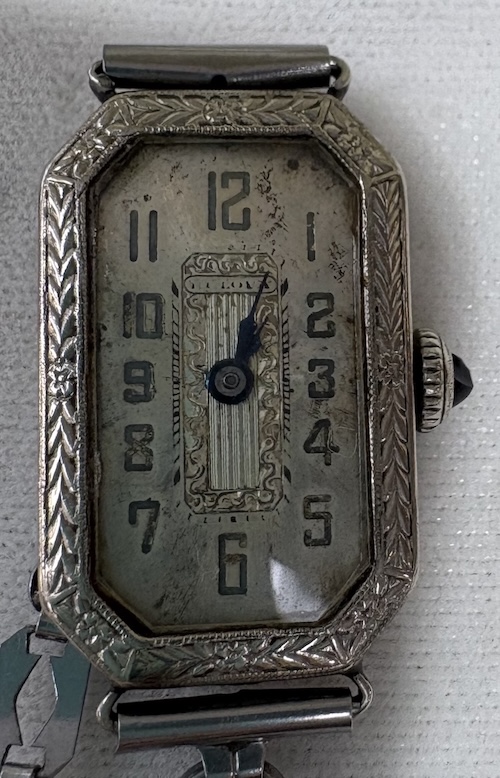
I rediscovered this watch in my jewelry box a few months ago and had the vague memory that it was my grandmother’s watch but not the one she usually wore. I showed it to my mother and it looked familiar to her, but she was quite sure she hadn’t seen her mother wearing it. Usually we both remember things like this, so it is unfortunate that we don’t in this case.
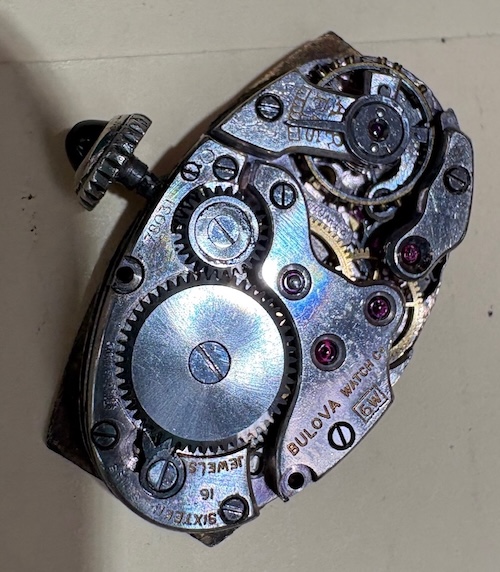
From lots of enjoyable and educational looking around this website, I think it is likely that the watch is a Pater. I see a circle-shaped symbol on the movement by two screws near the crown, which I believe indicates it was made in 1925. I’m very interested to know if you concur with that style and date. 16 jewels seems to be unusual, and I wonder if there’s any information to be gleaned from that.
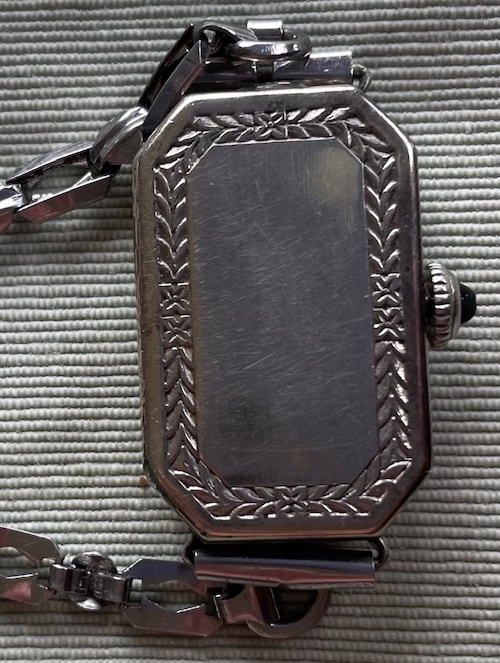
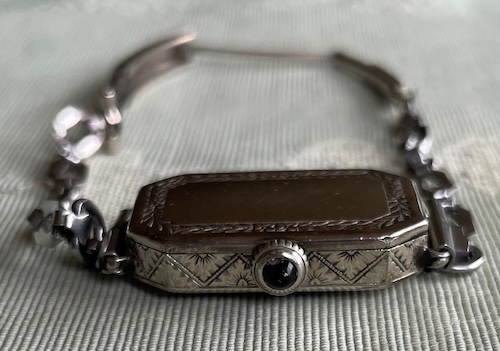
My grandmother graduated from high school in 1925 and then, in 1926, finished an extra year in another high school to learn secretarial skills. Her parents were farmers and their financial situation was such that it is very unlikely they would have bought her a gift like this watch. But she worked, boarded, and sometimes traveled with a wealthy family as a nanny so she could stay in Portland, Oregon to attend high school. Our leading theory is that they bought her the watch as a graduation gift. If so, my guess is that she wore it regularly for a while—it shows signs of wear on the back and has a chip on the sapphire—and then got another watch around the time of her marriage or when my mother was very young, which would be the mid-to-late 1930s. This is a lot of speculation, but if you notice anything about the watch that supports or confirms this theory or notice anything that might suggest anything else about its story, I’d love to know.
Another theory is that she found the watch at a yard sale. She always looked for finds and had some good ones.
The bracelet strap fits me well and I wonder if someone had it fitted for me. The bracelet seems to be newer and a different material from the watch and clasp, which both seem to be white gold, filled gold in the case of the watch. The clasp says, “Kreisler quality USA gold cont. .025-pat.2.064760.” That patent is from 1936 (https://www.uspto.gov/web/offices/ac/ido/oeip/taf/filingyr.htm), so the clasp is not the original.
We took the watch to a jeweler. The spring was broken, and we had it replaced. We had it cleaned, though asked for just a light dusting of the face. The watch is working now.
I’m enjoying wearing it and am not interested in selling it.
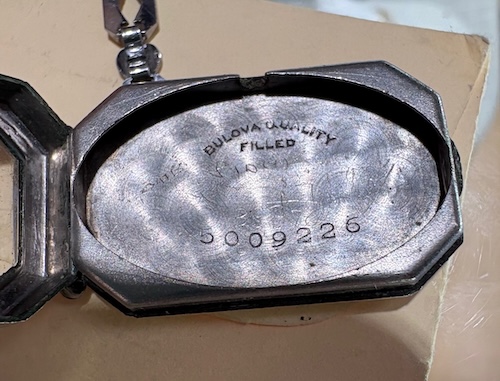
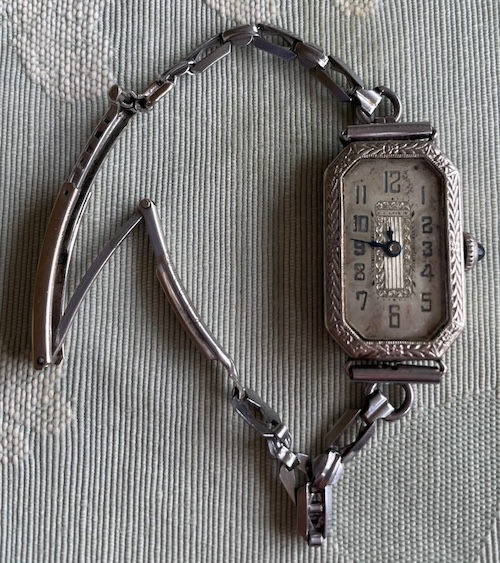

In reply to Thanks Alex. Based on this… by mybulova_admin
Here is another nice full page ad San Antonio Light Sun, Dec 14, 1924 ·Page 99
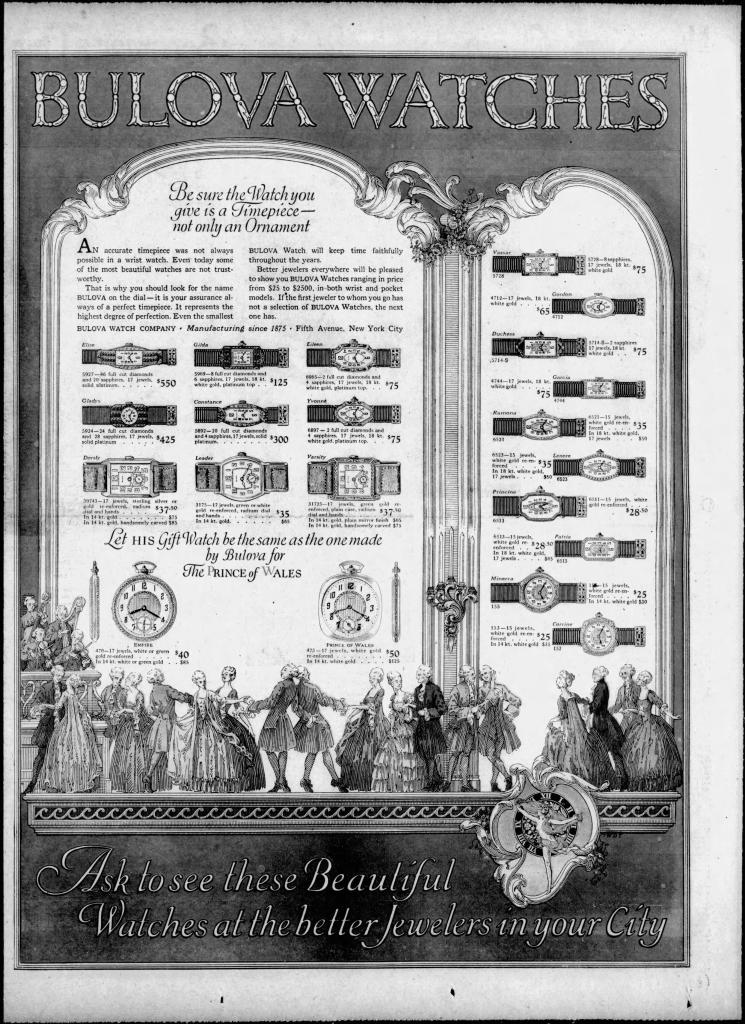
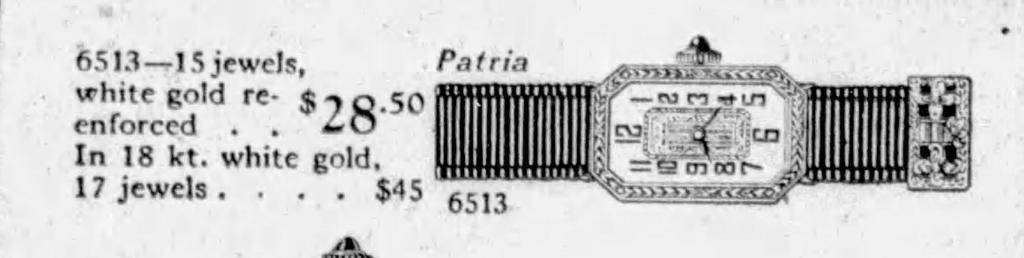
In reply to Here is another nice full… by Kathy L.
Interesting that this one says both Patria and 6513.
In reply to Interesting that this one… by KarinEg
Yes and probably because they were transitioning from the 6513 to Patria. That may have been the introduction of the new name.
We believe the subject watch to be early 1925. You said so yourself that was your way of thinking.
Fact is we have an official Bulova June 1925 advert showing the watch as a 6513. It was not known as the Patria until 3 months later for Spring 1925 line.
I agree that it was later assigned the model names, but if we really want to be correct and provide the most accurate ID, then the earliest ID seems the most appropriate for this watch.
A name is always nicer to have but isn't always accurate. If we as a group want to discount how watch names changed over the course of a year, then we would still be correct in naming it a Pater.
For my money the most accurate model ID is the earlier model number.
I am voting for Patria. Here are 3 ads from Dec 1924. Thank you for sharing the story of your grandmother's watch, it is a lovely heirloom.
The_Tampa_Tribune_1924_12_14_99, The_Chehalis_Bee_Nugget_1924_12_12_Page_19, The_Birmingham_News_1924_12_20_24


1925 Bulova Patria

I guess I'm voting based on the late 1924 ads naming it, as the ads precede the watch's production.
1925 Patria
Does anyone have a sense of what happens to these watch faces over time and how they are cared for to know what to make of the condition of the face? Why would the paint be fainter on the upper corner of the inner design and markings? (From the condition of that area it was a triumph when I figured out it said Bulova!) And what are the black marks?