
I did a little research and figured out what each letter of the Bulova movement numbers mean. This may be written down somewhere but I’ve never seen it. This applies to mechanical movements only.
After the first 2 letters, every letter after that has a specific meaning.
A = Automatic
B = Day-Date
C = Sweep seconds
D = Calender (date)
F = No seconds hand
L = No seconds hand
H = Hack
R = Alarm
S = Glycidur balance
U = Jump Hour
I found one exception to the use of the R. The 10BMCHR doesn’t have an alarm function. All the other movements I found with an R are Wrist Alarm’s.
The number at the beginning of the movement number is a direct reference to the size measured in ligne. For example, the 10BUC is a 10.5 ligne movement. For the movements that are not round, it refers to the smaller of the two measurements. As examples, the 6AB measures 6.75x11 ligne and the 8AH measures 8x9 ligne. Whether the number be 10.5, 6.75 or any other non whole number , the number is rounded down. There is one exception. The 14EFAD is a 13.75 ligne movement. Bulova rounded up on this one movement for some reason.
I cannot find any reference to the 10BMCHR movement. I think you mean the 10BNCHR which is on the train timer. I wonder if the R in this case is related to the Micro Regulator. It is possible the position of the R in the caliber number makes this different. The 11AERC the R is in the third position and would indicate Alarm but in the 11BNCHR it is in the fifth position indicating micro regulator. It sounds logical and fits perfectly into your assessment. BTW I had to look up the Glycidur balance. I had never heard of that before..
In reply to I cannot find any reference… by JimDon5822
So I think your list should be updated as follows:
After the first 2 letters, every letter beginning in the 3rd alphabetic position has a specific meaning.
- A = Automatic
B = Day-Date
C = Sweep seconds
D = Calender (date)
F = No seconds hand
L = No seconds hand
H = Hack
R (leading R- 3rd position) = Alarm - R (trailing R- 5th position) = Micro regulator
S = Glycidur balance
U = Jump Hour
I am surprised there was not a micro rotor designation letter.
In reply to What is a 'jump hour'… by mybulova_admin
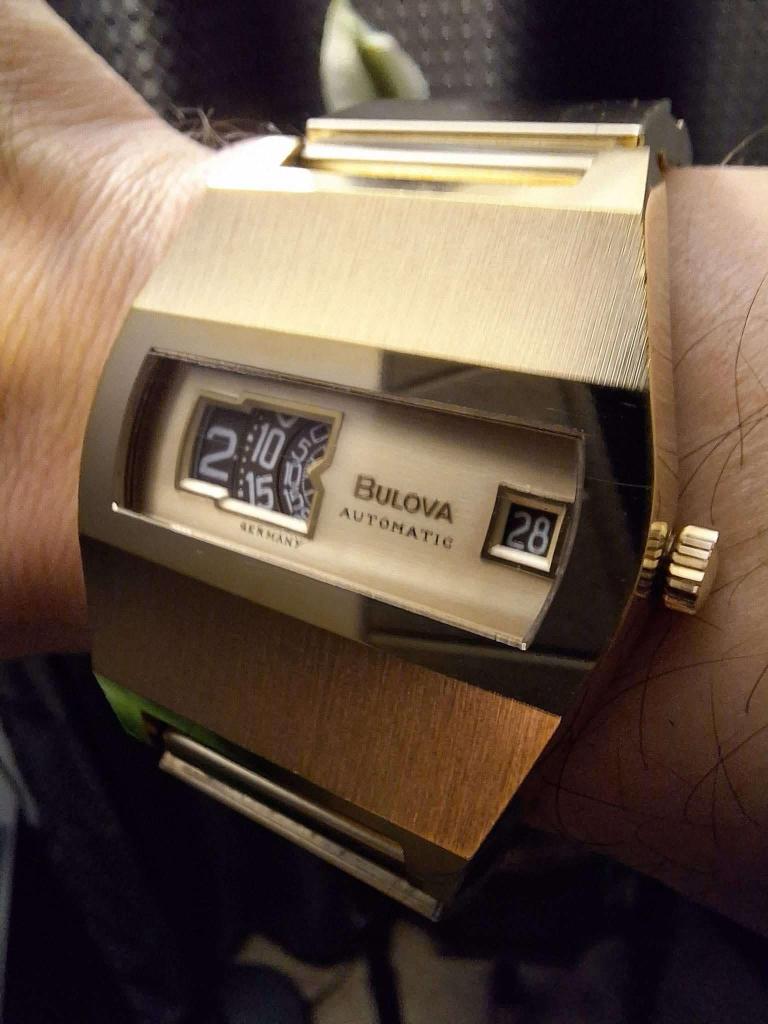
In reply to From Stinky. Jump hour… by JimDon5822

In reply to From Stinky. Jump hour… by JimDon5822
I also refer to these as 'Jump Hour' but I believe 'Digital' may be the correct industry terminology. My grail watch is a digital, a A. Lange & Söhne Zeitwerk, an amazing blend of vintage and modern horology and esthetics.
In reply to I also refer to these as … by GuyMontag
Both terms are corrrct. BuLova used the term Jump Hour in 1932. Jerin has one in the database.. https://mybulova.com/watches/1932-jump-hour-2860Jabs has one also. https://mybulova.com/watches/1932-jump-hour-6417
BuLova used the term digital in 1974. I prefer the term Jump Hour because digital also applies to LED and LCD watches. Jump Hour has no alternate application.
In reply to I also refer to these as … by GuyMontag
A jump hour is technically an early digital. Instead of a dial, it has an hour and minute wheel. The hour wheel doesn’t slowly rotate. It jumps from one number to the next. There are 5 in the member watches from the 1930’s but Bulova made them in the 70’s also. There’s one posted in the Faceygroup from 1974. It has hours, minutes, seconds, date, and it’s an automatic. I believe it has the 11OWAUD movement. I’d post a picture but I don’t know how. I’ll send Jim a picture and he can post it.
To answer your last question, yes, all these letters apply to Bulova movements. You can look at any movement number and identify all its functional features without have to see the movement itself. Using the 11OWAUD as an example. After the first 2 letters, it has AUD. A is automatic. U is jump hour. D is date.
In reply to A jump hour is technically… by Stinky_Sullivan
Geoff has a ‘74 model in the database.
In reply to Geoff has a ‘74 model in the… by Stinky_Sullivan
In reply to A jump hour is technically… by Stinky_Sullivan
In reply to Ok so it's a jump hour in… by mybulova_admin
In reply to Disregard the first 2… by Stinky_Sullivan
In reply to Ahh penny dropped. These… by mybulova_admin
As to your last question, some of the very early movement numbers have 3 letters like the 6AAI. I do not know what the I stands for. The 6AMC is the earliest example of more than 2 letters being used with this nomenclature m. It appears that as soon as Bulova started using a 3rd letter other than “I” that it applied. Unless there’s an earlier example, 1940 is when this started. There’s no 6AMC in the database here. I found it listed on Watchophilia.
In reply to As to your last question,… by Stinky_Sullivan
In reply to Disregard the first 2… by Stinky_Sullivan
In reply to I found a movement number… by Stinky_Sullivan
In reply to Same with the 10BRC. Others… by GuyMontag
In reply to When I find the time, I will… by Stinky_Sullivan
In reply to Thanks for the great work. … by JimDon5822

In reply to i wonder if the second… by mart1n888
The P doesn’t mean anything on its own. The only time we see the P is when it is a double letter. Other examples of double letters are the 11AFF, 11ALL, and 11BLL. In each case, the 3rd letter is a duplicate to the 2nd. All of these movements lack a seconds hand entirely.